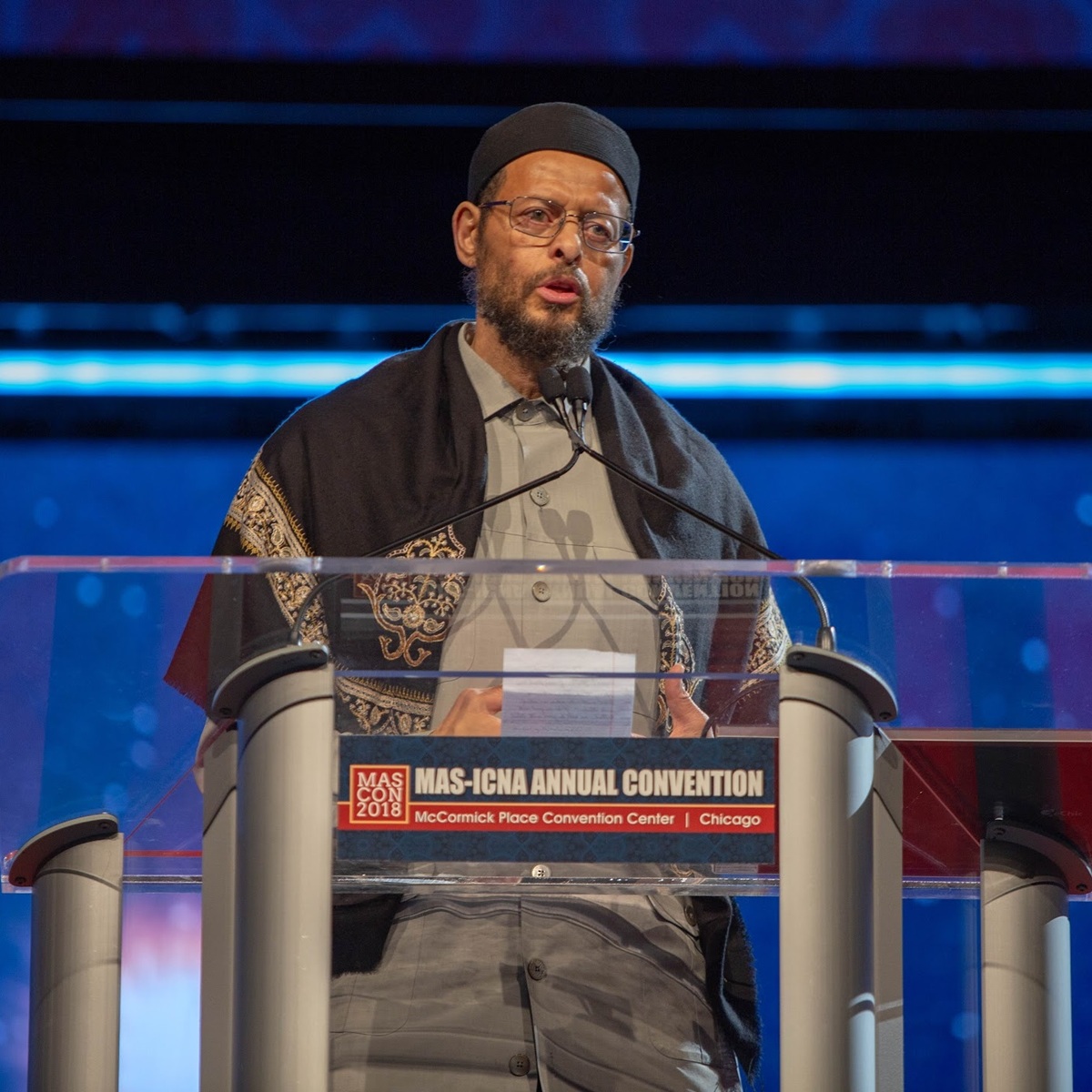
About Imam. Zaid
Imam Zaid Shakir is amongst the most respected and influential Muslim scholars in the West. Born in Berkeley, California, the second of seven children he accepted Islam in 1977 while serving in the United States Air Force. He then obtained a BA with honors in International Relations at American University in Washington D.C. and later earned his MA in Political Science from Rutgers University, where he emerged as an active leader in campus activities, helping to revive the Muslim Student Association, co-leading a successful South Africa divestment campaign, and co-founding a local Islamic center, Masjid al-Huda. After a year in Cairo, Egypt, studying Arabic, he settled in New Haven, Connecticut and continued his tireless activism, co-founding Masjid al-Islam, the Tri-State Muslim Education Initiative, and the Connecticut Muslim Coordinating Committee. As Imam of Masjid al-Islam from 1988 to 1994 he speared-headed a community renewal and grassroots anti-drug effort in the local neighborhood, and also taught as an Adjunct Professor of Political Science and Arabic at Southern Connecticut State University until his departure for Syria to further his studies in the traditional Islamic Sciences. Studying Arabic, Islamic law, Quranic studies, and Islamic spirituality for seven years in Syria, and briefly in Morocco, with some of the top Muslim scholars of our age, he graduated from Syria's prestigious Abu Noor University in 2001 and returned to Connecticut to continue his work with the Muslim community in America. Teaching frequently as the Imam of Masjid al-Islam, writing numerous articles for various magazines, journals, and newspapers, and lecturing regularly at many of the largest Muslim conferences and conventions, he soon emerged as one of the most popular and sought after American Muslim leaders. He has translated three books from Arabic into English, including “The Heirs of the Prophets” which was published in 2001. In 2003, he moved to Hayward, California with his family to serve as a scholar-in-residence and lecturer at Zaytuna Institute. He is widely regarded as an articulate voice on Islam and African-American issues and a leader in the emergence of an Islamic tradition indigenous to America that seeks to reconcile traditional teachings with an experience that is uniquely western.